Calibration is the step where the performance team checks the grades produced by the scorecards before they are final, so one manager’s “Advanced” means the same as another’s. This guide turns the calibration step of the performance management framework into a running order you can use. It is adapted from the Performance Management Playbook; the detailed playbooks come from QuantumLight, and Ash did not author them.
Where this fits: calibration is step 4 of the 5-step performance management framework. This page is the meeting. For the definition, methods and a software checklist, see what performance calibration is. Next step: before the meeting, check draft ratings for the five common review biases.
Before the meeting
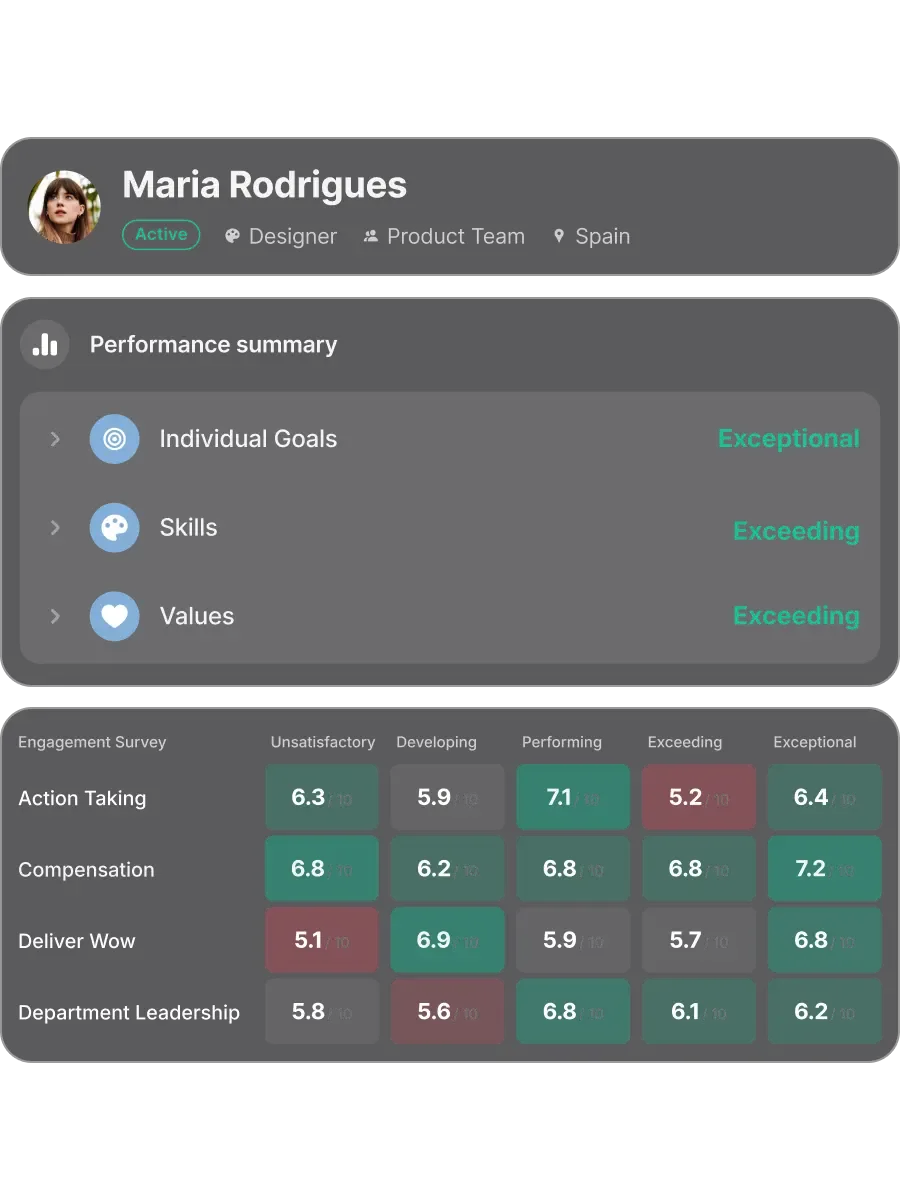
- Scorecards are complete. Managers have filled in deliverables, skills and culture scorecards (about 1 to 2 weeks in the playbook’s cycle).
- Grades are calculated from the scorecards on the five-level scale, so the meeting reviews results rather than building them.
- The talent bar is published for each seniority level, so every outlier can be mapped to above, at or below the bar. See publish a talent bar by seniority.
- Time is boxed. The playbook allows about a week at most for calibration including senior leadership review.
The three checks
| Check | What to look for | What to do |
|---|---|---|
| Generous graders | A manager rates too many people at the top, for example half of one team as A-players | Ask the manager to identify the strongest performers so the top band stays credible |
| Missing or thin evidence | Scorecards not filled in, or weak justifications | Follow up with the manager straight away so the cycle is not delayed |
| Outliers and sudden jumps | Someone previously graded above bar receives an Exceptional score in one area | Examine whether the improvement is genuine or a grading mistake |
Revolut People flags the same three patterns automatically before the meeting: Line Manager or Functional Manager Leniency, a grade not supported by deliverables or Bar Raiser answers, and a historical performance decline or improvement, each compared with the person’s last four cycles.
A running order
A suggested order built on the playbook’s checks (the order is a practical suggestion, not a prescribed agenda):
- Confirm completeness. List missing scorecards and thin evidence notes and assign owners.
- Scan each team’s grade spread against the three groups: A-players, above bar and underperformers.
- Discuss outliers first: unusual highs, lows and jumps, with the evidence on the scorecard.
- Test borderline grades against the bar for the level, not against other people or how pleasant someone is.
- Record adjustments and the reason for each.
- Send to senior leadership for review and approval; leadership also spots teams that need more attention.
- Announce results and let managers discuss them in the weekly 1:1.
What to record
For each change: the original grade, the adjusted grade, the reason, the evidence, and who approved it. The calibration notes section of the performance review template has worked examples.
Caveats
The playbook’s guideline weights (A-players about 15-25%, above bar 65-85%, underperformers 0-10%) are its own, not an industry benchmark. Published research on capped rating curves is mixed, and one study found employees nominated for a capped top tier but not awarded it were at least 34% more likely to leave voluntarily. Use the weights as a prompt for discussion, not a quota. Details and sources are in the evidence and caveats section. For the line between a forced quota and an evidence check, see stack ranking vs calibration.
More reading: Gartner 2026 on reviews and calibration and why annual reviews fail.
Why not use a 9-box grid in calibration?
A 9-box puts two opinions (performance and “potential”) on a grid, which tends to bring the bias back into the room. Calibrate against scorecard evidence and the talent bar instead. Full argument and alternatives: why the 9-box grid is dead.
Practise first: try the calibration simulator with fictional example employees to see how the rating distribution shifts and which rater-bias patterns show up.
Calibrating at 500+ people
The steps above work as written up to a few hundred people. As a company approaches 500, one meeting can no longer cover everyone, so the same checks run in two tiers. This section covers the structure, roles, agenda and time it takes.
Why 500 people changes calibration
Three things happen as a startup approaches 500 employees. First, there are now 50 to 80 people managers, many promoted in the last two years and rating people for the first time. Second, departments have developed their own norms: engineering may rate tough, sales generous, operations in the middle. Third, leadership no longer knows everyone, so it cannot sanity-check ratings from personal knowledge. That is why it pays to train managers before calibration.
The result is the problem Kahneman and colleagues call “noise” in Harvard Business Review: people applying the same guidelines reach different judgements on similar cases. Research summarised in HBR’s “Reinventing Performance Management” found that a large share of the variance in ratings reflects the rater rather than the person rated. Calibration is the step that catches this before ratings drive pay and promotion.
McKinsey’s 2024 article “In the spotlight: Performance management that puts people first” describes committees as a way to bring diverse perspectives and mitigate individual managers’ biases, and suggests combining manager judgement with committee review. A tiered calibration does exactly that.
Two tiers, not one giant room
Do not try to calibrate 500 people in one meeting. Split it into two tiers.
| Tier | Who is calibrated | Who attends | Length |
|---|---|---|---|
| Tier 1: department sessions | Everyone in the department, typically 40 to 120 people | Department head, the managers whose reports are discussed, a People partner as facilitator | About 90 minutes to 2 hours per session |
| Tier 2: leadership session | Top and bottom ratings, promotion nominations, cross-department outliers | Executive team, Head of People, People partners | About 2 hours |
In Revolut People this maps to Structured calibration: up to five stages (for example team, then department), each with its own scope and calibration owners, and calibrators can’t change grades outside their scope.
For a 500-person company that usually means five to eight department sessions, plus one leadership session. Large departments (often engineering) can split by sub-function so no session discusses more than about 80 people. Session lengths are illustrative; the goal is that the room has time to discuss outliers, not every individual.
Who does what at scale
- Facilitator (People partner). Owns the pre-read, keeps time, asks for evidence and logs every change. Does not argue for or against individual ratings.
- Department head. Owns the outcome for the department and makes the call when managers disagree.
- Managers. Present evidence for their top and bottom ratings and accept challenge from peers who have worked with their reports.
- Head of People. Chairs Tier 2, checks consistency across departments and owns the final sign-off process.
The department session agenda
| Time | Item | Owner |
|---|---|---|
| 0–10 min | Ground rules: we discuss evidence, not personalities; the bar is the reference; changes are logged | Facilitator |
| 10–25 min | Distribution review by manager: who is rating high, low or flat? | Facilitator |
| 25–60 min | Top ratings: each manager evidences their A-player ratings against the bar | Managers |
| 60–85 min | Bottom ratings and underperformance: evidence, prior conversations, next step | Managers, People partner |
| 85–105 min | Outliers and jumps: anyone whose grade moved sharply, plus missing or thin evidence | Facilitator |
| 105–120 min | Read back changes, confirm promotion nominations for Tier 2 | Department head |
Notice what is missing: walking through everyone rated in the middle. At 500 people that is most of the company, and the evidence for “meets the bar” is rarely contested. Spend the time where decisions are made.
The leadership session
Tier 2 does not re-run department calibration. It looks across departments. Bring a single view of the distribution by department, the list of promotion nominations, everyone rated at the top and bottom, and any rating the department session could not agree. The executive team’s job is to check that a top rating in engineering represents the same standard as one in sales, approve promotions, and spot teams that need more attention. The playbook allows about a week at most for calculation, calibration and leadership review together.
After calibration at scale
Tell managers the final results before employees hear them, and brief them on any rating that changed so they can explain it. Results are then discussed in each employee’s next 1:1, with a clear next step: promotion path, development focus or improvement plan. Book a 30-minute retrospective with the People team to note what slowed the cycle. Once performance grades are final, the next room is often the talent review — critical roles, ready-now and ready-later names, or an honest gap. See succession planning for People teams.
Common mistakes at 500 people
- One huge session. A room of 40 managers discussing 500 people produces fatigue, not fairness.
- Calibrating without the bar. If the standard is not written down, the most senior or most persuasive person sets it in the room.
- Discussing everyone. Focus on the top, the bottom and the outliers.
- Letting changes go unrecorded. Undocumented changes are hard to defend and impossible to learn from.
- Skipping the cross-department view. Without Tier 2, each department is internally consistent but the company is not.
How much time calibration takes at 500 people
Six department sessions of two hours with eight people, plus a two-hour leadership session with ten, is 96 + 20 = 116 person-hours per cycle (illustrative figures). Put your own numbers into the review cost calculator to see what calibration costs your company each year, and where pre-reads and tighter agendas would save the most. For a ready-to-copy agenda and log format, use the calibration meeting template for mid-market tech companies.
Sources: Kahneman et al., Noise, HBR (2016); Buckingham & Goodall, Reinventing Performance Management, HBR (2015); McKinsey, In the spotlight (2024). Session structure and timings are illustrative playbook guidance.
If you run calibration in Revolut People: heads of department or function review and adjust submitted ratings after the review period, and the Calibration tab in Manager Hub brings progress, grades, status and comments together. More short films
Related guides
Stack ranking vs calibration: why forced ranking fails and what to use · Year-end performance review: HR run sheet and template · Performance calibration: what it is and what calibration software should do · Performance management framework: scorecards, talent bar and calibration · performance review template with worked examples · staff appraisal template (UK) · employee performance rating scales explained · performance management software buyer’s guide · People Performance Playbook home · merit matrix: how to link ratings to pay · succession planning for People teams
Free tools: estimate what your review cycle costs with the performance review cost calculator, or see if your HRIS is holding performance back with the HRIS switch checker.
FAQ
What is a performance calibration meeting?
It is the step where the performance team checks the grades from the scorecards before they are final, then senior leadership reviews and approves them. The aim is that grades mean the same across managers.
What should we check in calibration?
Three things: managers who rate too generously, missing scorecards or thin evidence, and outliers or sudden jumps that need explaining.
How long should calibration take?
In the playbook’s quarterly cycle, grade calculation and calibration take about one week at most, including senior leadership review.
Should we force a distribution of grades?
The playbook gives guideline weights of 15-25% A-players, 65-85% above bar and 0-10% underperformers, but they are its own guideline and not an industry benchmark. Research on capped curves is mixed, so keep calibration evidence-based.
What happens after calibration?
Results are announced and discussed in each employee’s weekly 1:1, and can lead to a promotion path, development, a performance improvement plan or a pay change. If pay follows the grade, a merit matrix is the usual next step after calibration.